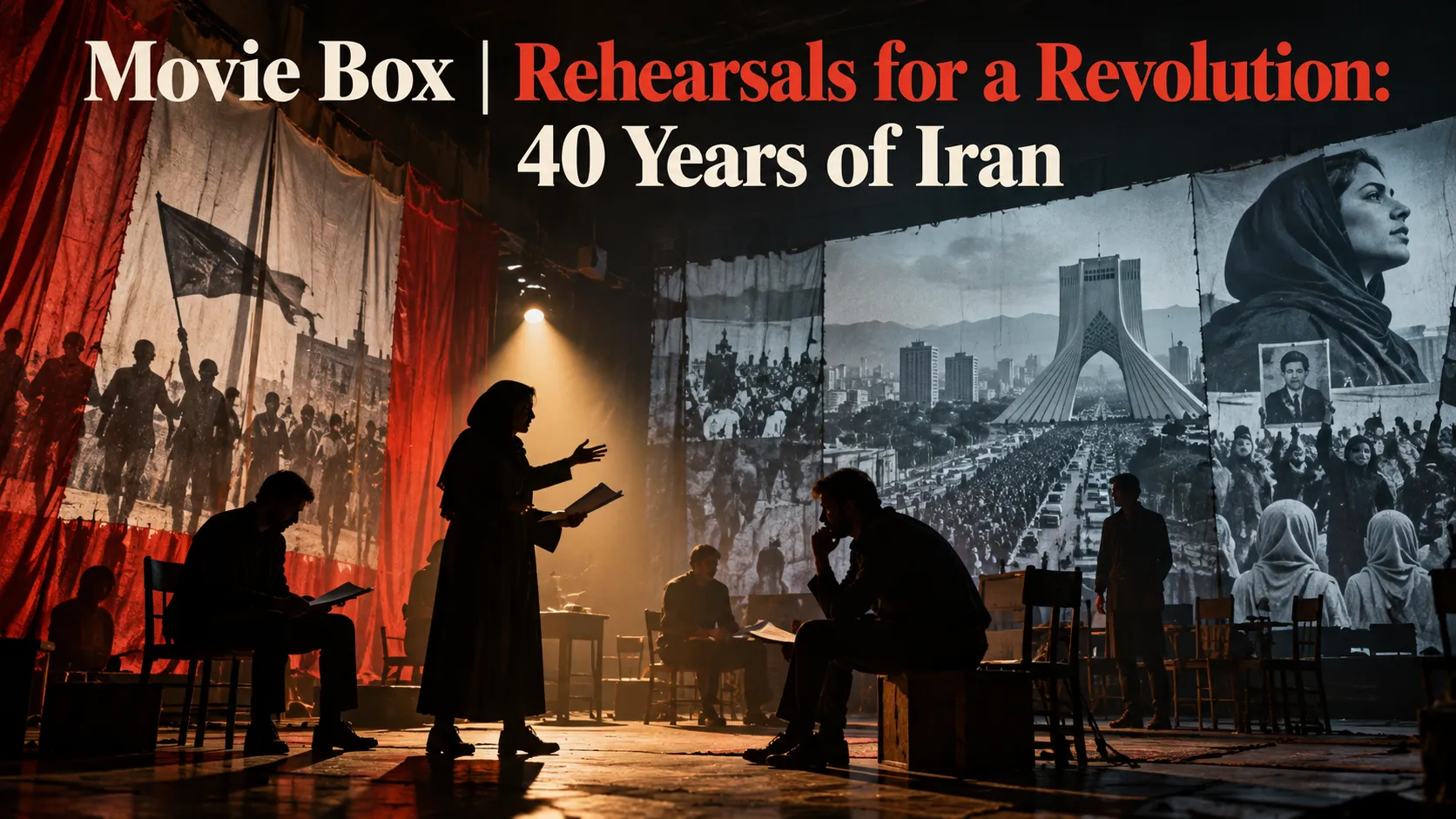
Movie Box | Rehearsals for a Revolution: 40 Years of Iran
Updated on October 27, 2026App Info
| Genre | |
|---|---|
| Requires | android Android 5.1 |
Rehearsals for a Revolution sees Ahangarani trace 40 years of Iran, from 1979 to the 2026 war, via home videos and protests. Sony Pictures Classics, 8 Jan 2027.
Movie Box | Rehearsals for a Revolution: 40 Years of Iran
Rehearsals for a Revolution is a 2026 documentary film in which Iranian filmmaker and actress Pegah Ahangarani retraces four decades of Iran’s modern history.
Different from the conventional ways of explaining Iran, Ahangarani focuses on people she knows, relatives and mentors, and those whose lives have been changed by the political upheavals, including members of the resistance.
To portray her story, Ahangarani incorporates home movies and photographs, and uses her family’s audio and video archives, as well as newspapers and video footage of street demonstrations.
The film starts in 1979, with the Islamic Revolution, and goes to 2026, providing an overview of Iran’s modern history. It will be released by Sony Pictures Classics in the United States on January 8, 2027, in select theaters.
The Documentary is Structured around Five Stories
Ahangarani structures her film around five major portraits.
Each chapter focuses on a relative or mentor who has experienced a particular form of resistance or survival.
This helps avoid a monotonous and repetitive documentary.
The documentary effectively combines Ahangarani’s reflections on major political and social events with the effect these events had on ordinary people.
The documentary is made of five chapters that are arranged in a horizontal, chronological order. Each chapter is different from the others, in terms of visual style and first-person narration.
Readers finding this title through the keyword movie box download play store should note that this is a nonfiction documentary distributed by Sony Pictures Classics, in the United States.
The documentary explores the ways the memory and political repression of Iran affect ordinary citizens and how they continue their life after turbulent events.
Beginning with 1979 Revolution
1979 revolution changed the political system of Iran and established the Islamic Republic.
Ahangarani was born a few years later, but the revolution changed her life and impacted her family and surrounding community.
The documentary uses family materials to show the connection between her life and the events that impacted her family and community before and after her birth.
Cannes describes the film as looking back to the beginning of 1979 and tracing it through to 2026 war.
It explores the different phases of the political upheaval and social unrest that followed the revolution, such as the repressive measures, public demonstrations, and political movements.
Rather than looking at each of these episodes in isolation, Ahangarani provides a holistic view of the long term struggle for political and personal freedom of the Iranian people.
Using home videos and photographs as historical documents provides a very long term perspective to memory.
Some of the home videos, pictures, and other footages that she uses in the documentary were never made public or meant to be used in a documentary.
This makes the documentary very personal and gives it an engaging and emotional storyline.
Family home videos, private photographs and films can help give context to large historical events of a nation. Footages of public demonstrations can show why people remember events in a certain way.
IDA states that the film gives a realistic and emotional portrait of Ahangarani and other Iranians and makes a compelling case for peace.
For users finding the film using the search term “movie box official website” in their searches, these archival elements are central to understanding what makes the documentary different from a typical political overview.
Pegah Ahangarani Tells Her Own Story
Ahangarani has also been a central figure in the film as an actor and director.
In the 1990s and 2000s, she acted in dozens of Iranian films. She shifted her focus to documentary filmmaking in the 2000s.
In an interview prior to the film’s premiere at the Cannes Film Festival, Ahangarani said the film was partially therapeutic because it allowed her to revisit and confront the pain that her family, friends and the people of her country had endured for over 25 years.
The screenplay credits also include Ehsan Abdipour, Amir Ahmadi Arian, Arash Ashtiani, and Majed Neisi.
Kaveh Farna, Adrià Monés, Parnian Farnam, Ahangarani, and Ashtiani are listed as producers, and Ashtiani edited the film. The production is officially co-represented by the Czech and Spanish Film Commissions.
The film won the L’Œil d’Or at the 2026 Cannes Film Festival for best documentary.
Rehearsals for a Revolution had its world premiere at the 2026 Cannes Film Festival in the Special Screenings section.
It has since been screened at the AFI FEST and Telluride Film Festival.
There are slight differences in the running times.
Cannes lists the running time at 95 minutes and the International Documentary Association has a 98-minute version.
The differences are likely due to variations in the festival/presentation versions and not major changes in the film.
Rehearsals for a Revolution will open January 8
Sony Pictures Classics has Rehearsals for a Revolution scheduled to open in select U.S. theaters on January 8, 2027, after qualifying runs in December 2026.
The documentary does not take a Chronological approach to portraying modern Iran.
Rather, Ahangarani poses the question of how did those events manifest in people’s lives, friendships and families?
Political movements and uprisings become memories. Private recordings co-exist with public protests. Persons become subjects of events of national import.
This perspective is the soul of the documentary.
It is also an attempt by the filmmaker to come to terms with what shaped and altered her family, friends and the people she has known over the years and what lies behind the continuous yearning for reform and the hope for a better tomorrow.